Artificial intelligence (AI) has marked a major step in the evolution of digital technology. Becoming increasingly integrated into our daily lives—and even more so within companies seeking innovative solutions to enhance user experience—chatbots play a central role. However, there is a fundamental difference between a simple chatbot and an AI agent, a distinction that directly impacts their effectiveness.
So, how do you know which type of conversational assistant best fits your business needs? Let’s dive into the world of AI agents and discover what truly sets them apart from simple bots!
- The Simple Chatbot: Scripts and Limitations
A simple chatbot, or rule-based bot, is an automated program that responds to predefined questions. It’s perfect for automating frequent responses in FAQs, on e-commerce sites, or in basic booking systems.
The main advantages of a simple chatbot are its quick setup and low cost. However, its greatest weakness lies in its rigidity. It doesn’t truly understand user language, relying instead on keyword recognition. If a question is phrased differently or falls outside the script, the bot fails to deliver a relevant answer.
Example: A simple chatbot for a pizzeria might answer “What are your hours?” but fail to respond to “Are you open on Sunday evenings?” since the phrasing doesn’t match its script. - The AI Agent: Intelligence That Understands and Learns
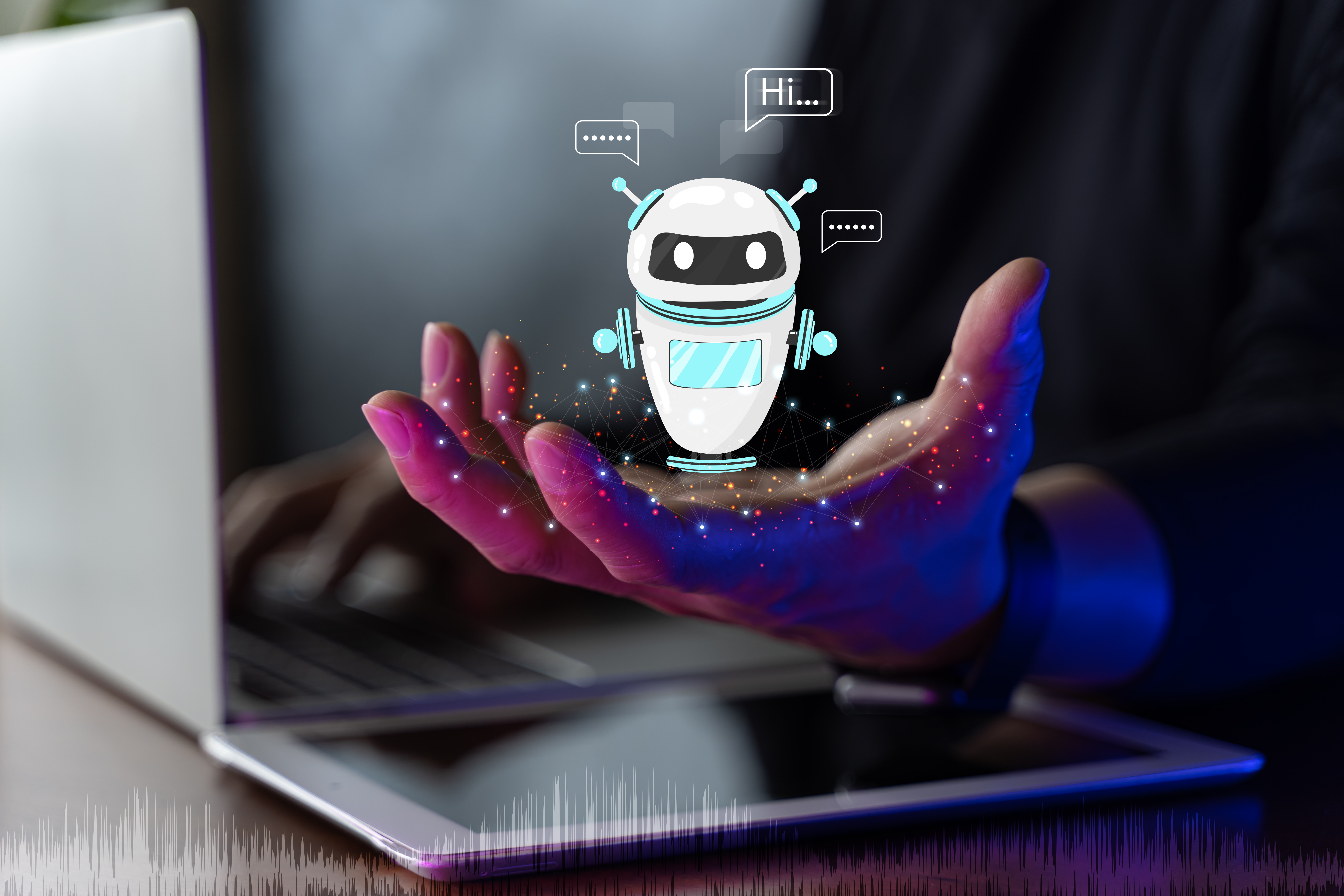
An AI agent is a software system designed to perform tasks for a user (or another system). It can be configured to reason, plan, remember, and act with a degree of autonomy.
Unlike simple chatbots, AI agents (or AI chatbots) represent a technological leap. Using Natural Language Processing (NLP), they understand the meaning of sentences—even if they are complex or poorly phrased. They don’t just follow scripts: they learn from interactions, adapt, and improve over time.
Often integrated with databases, CRMs, or internal tools, AI chatbots can perform advanced tasks such as:
- Scheduling appointments
- Recommending products or analyzing customer behavior for personalized responses
For example, a bank’s customer service AI agent can handle requests 24/7. It understands both “I want to block my card” and “I lost my wallet, what should I do?” and provides tailored solutions.
- An AI Chatbot for an Optimal User Experience
The main advantage of an AI agent is its direct positive impact on user experience. Where a simple bot frustrates users with irrelevant responses, an AI agent makes interactions smoother. It understands intent, asks follow-up questions if needed, and delivers accurate, coherent answers.
AI agents can also be multilingual and omnichannel (integrated into websites, social media, mobile apps, etc.). They continuously learn from past interactions, offering a more human, high-quality service without requiring a constant human presence.
Comparison Table: Simple Chatbot vs. AI Agent
| Feature | Simple Chatbot | AI Agent |
|---|---|---|
| Main Technology | Rule-based, keyword recognition | Artificial Intelligence (AI) and Natural Language Processing |
| Capabilities | Responds to predefined questions, follows scripts | Understands meaning, learns from interactions, handles complex tasks |
| Learning | Static, no learning capability | Continuous learning, improves over time |
| Personalization | Limited, no context awareness | Advanced personalization based on user, history, and context |
| Integrations | Limited or none | Can integrate with CRMs, databases, business tools |
| Task Complexity | Simple tasks (e.g., sharing a link, displaying info) | Complex tasks (e.g., booking appointments, processing returns) |
| User Experience | Can be frustrating if queries don’t match script | Smooth, intuitive, and conversational |
| Cost & Deployment | Low cost, fast implementation | Higher initial cost, but long-term ROI |
- How to Choose the Right Solution for Your Business
The choice between a simple chatbot and an AI agent depends on your company’s goals. If you only need a basic assistant for simple questions, a chatbot may be sufficient.
However, if your goal is to automate part of your customer relations while delivering a high-quality user experience, the AI chatbot is the better option.
Industries such as healthcare, banking, tourism, and e-commerce are already adopting these intelligent solutions, achieving faster response times, improved customer satisfaction, and freeing up teams for more strategic tasks.
The difference between a simple chatbot and an AI agent lies in the very structure of their programming. An AI chatbot doesn’t just respond—it understands, interacts, and learns. A simple chatbot, on the other hand, reacts only to a defined script, limiting its interaction capabilities.
If you want to deliver a modern, responsive, and personalized user experience, it may be time to upgrade your strategy.
Explore today’s many AI chatbot solutions and discover how they can transform your customer service and conversion funnel!